|

 |
|
|
 |
Wildflower Safari
by Hildy Gottlieb
Copyright ReSolve, Inc. 2001 © |
|
 |
|
|
| YOU WOULD THINK
we were photographing wild animals, not wildflowers.
Photographing wildflowers is supposed to be idyllic, calm. |
|
Like
this:
It's 1995. A man I
admire has passed away, and when I hear about it, I head to the serenity of
Picacho's wildflowers. As one of Tucson's power elite, he'd made time for me as
a young social activist looking for guidance. To celebrate his life and the
things he has taught me, I spend a reflective afternoon watching the light
dance upon the golden poppies.
That's what the
desert is supposed to be for - calming what ails you.
This year's search
for beauty and peace hasn't turned out that way. We've had mishap, excitement,
adventure. It's as if all this color and glory were created by mischievous
Greek Gods who, just for their own amusement, placed a spell upon the lives of
any who dare to capture it.
Not much calm, I'm
afraid. And when there has been calm, it hasn't lasted long. |
|
|
Our first
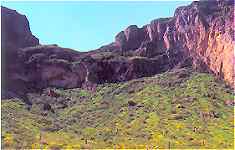
wildflower journey is to Picacho Peak, a place that attracts nature
photographers from all over the globe to shoot the craggy hillside of golden
poppies. The fact that it is 75° here and 20° everywhere else is
further inducement to those photographers, and to the retirees who have filled
the Picacho RV Park to brimming. Busloads of school kids complete the scene.
Idyllic it's not.
We climb slowly up
the gold-covered slopes, following the trail and then wandering off, shooting a
flower here, a million flowers somewhere else. As expected, we are not the only
photographers. As expected, the poppies are spectacular.
And there are a lot
of tourists. The folks from the RV park are everywhere, trying to pronounce the
names of the cacti. Occasionally we hear words that could be uttered by any
tourist, anywhere - "Honey, get the dog to look at the camera." The higher we
climb, though, the fewer the tourists.
 |
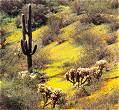 |
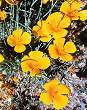
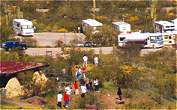
| The folks from the RV park are everywhere and, as
expected, the poppies are spectacular. |
|
 |
|
In the desert, the
temperature can range 40 ° from day to night. Mornings that start out cold
will quickly turn into warm afternoons. I have already taken off my jacket, and
now I tie my sweater round my waist as well. Within a few yards, I remove the
last possible layer, my flannel shirt. Now I'm down to a tank top, schlepping
an overnight trip's worth of clothes along with my camera
equipment.
It's 11am and we're
almost to the top. Dimitri wants to finish the hike and look over the saddle to
distant Tucson. It should just take 10 minutes, and then we can leave, with
time to spare before a 2pm phone appointment from back east.
Weighted down by
everything I'd been wearing, I decide to stay where I am. I unload my stuff
onto a huge flat rock alongside the trail and look around for a while. Then I
climb up next to my pile, listening to the sounds of spring - the birds, the
breeze.
Dimitri should be
back any moment. So I lay back and stare at the sky, putting the pile of
clothes under my head. The sun is warm on my face, and the breeze is cool. The
world is finally perfect.
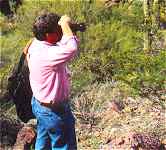 |
| Dimitri wants to finish the hike and look over the
saddle to distant Tucson. |
|
 |
|
A few minutes pass.
People coming down the trail sound like they are far away, and I realize I'm in
that half-dozing state just before a nap. I adjust the clothes and curl up,
laying on my side here on my rock, and fall soundly asleep there along the
trail.
Every few minutes
something registers. Individuals go by - no voices, but one is whistling a tune
along the way. Then a guy talking about an old west town in California that has
a better shoot-out than the OK Corral. I tell myself to remember the name of
the place, but within minutes, I don't.
It's after noon
when I finally wake up. Could I really have been asleep for an hour? On a rock?
And where is Dimitri? Is he still climbing to the top? He certainly can't have
missed me - my rock is right alongside the trail!
I know if I go
looking for him, we will spend the rest of the day missing each other. So I
sit, enjoying the sun and the sky and the birds. After about 10 minutes,
Dimitri comes climbing UP the hill towards me.
"You're coming UP?"
I ask. "Where have you been?"
"The parking lot.
The rest rooms. Looking for you."
"I've been right
here on this rock. I slept here for an hour."
We head down and
find the problem. In that whole two mile stretch, there is only one place where
one could veer off the trail, reconnecting within a few yards. Only one place
we could have missed each other, and it is 10 feet from where I was sleeping.
His trip to the top
had only taken 10 minutes, just as we had thought. And when he got all the way
to the bottom and didn't find me, he started combing the area, eventually
heading back up the hill.
"The higher I
climbed," he tells me, "everyone told me the same thing. 'She's asleep on a
rock.' "
So much for our
idyllic morning. Dimitri is tired and sweating - he's been up and down this
straight-uphill two mile trail twice now, the second time at a rapid pace,
afraid that maybe I'd been hurt.
We get to the car
and call the office. My phone appointment has been cancelled; it is snowing so
badly in Virginia that my client is heading home for the day. I don't have the
heart to tell her I missed her call because I was asleep on a rock, in a tank
top, in the sun, surrounded by poppies, my partner sweating from hiking up and
down in the 75° desert. |
|
|
IT'S BEEN ABOUT A WEEK since my snooze among the poppies. Spring has one last big storm
for us, and as the clouds start to break up, we head out to the desert to enjoy
those last few drops. The washes will be flowing, and the Brittle Bush, those
desert shrubs covered with hundreds of yellow daisies on silver-green stems,
will be in bloom against the patchwork of storm clouds.
The thought
of heading out into the possibility of cold rain, to capture flowering shrubs
on film has the kids - well - bored to death. But the joys of being a parent
include dragging your kids into things they think will bore them to death. My
parents did it to me, and I must pass this along to my daughter and Dimitri's
sons before they leave home without learning how to do it to their own
children. |
|
|
We hike into
the foothills of the Rincon Mountains. The washes flow with cold clear water
and the sky is threatening to rain in one corner, while turning from blue to
grey to puffy white in others. A winter storm, deciding which way to turn. The
brittle bush are yellow and beautiful. It's cold as we hike and shoot, and the
kids, true to form, are ready to leave from the moment we arrive.
Until we hear
them gasp from up ahead.
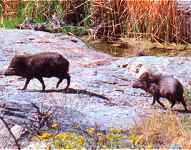
Javelina. Not
just one. A herd of javelina. We are surrounded.
Javelina
(ha-veh-leé-na) look like a short wild boar, with little skinny legs.
They travel in herds of up to 30, but it is unusual to see them during the day,
preferring to dig themselves a hole and settle in until dusk - feeding
time.
Their hair is
coarse and their personalities more so. They charge angrily when they feel
threatened. They are near-sighted and not too bright, which means they feel
threatened often. They get around by scent and run faster than you'd
think.
And their
tusks are sharp.
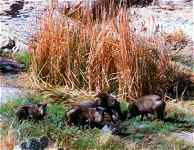 |
| Javelina. Not just one. A herd of javelina. We are
surrounded. |
|
 |
|
This is
exciting and scary all at once. We want to get close; we want to stay back.
They are all around us - a group of 3 here, a group of 5 or 6 there. They blend
into the desert, and the kids are calling, "There's more!" and "Over here!" and
finally, "Look - a baby!" They seem to know we are there, but don't seem to
care. They find puddles and wallow, like pigs. After a few rolls of film, we
hike back out, constantly looking behind us to be sure they haven't suddenly
decided we were a threat after all.
Do we have
pictures of the flowers? Some. The clouds? Some.
But we also
have 3 rolls of javelinas playing and just laying around.
And the kids
were NOT bored. |
|
|
|
|
A MONTH
LATER, it is almost the end of the
wildflower season. Our last chance. We pack everyone into the Suburban -
Dimitri's wife, Dyan, and his boys; my mom and daughter - and we head out the
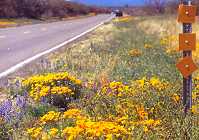
two lane road towards Kitt Peak. Along the way we see a bobcat, and lots of the
homemade shrines that mark a spot where someone has died.
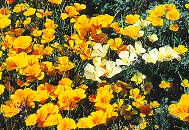
And suddenly, as if
tossed down from the heavens, a carpet of gold and blue and pink and white
spreads for miles in all directions. Faces are glued to the windows. Stop the
car! |
|
|
|
Others have stopped
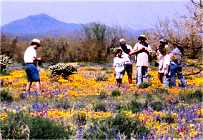
as well. And the crowd is so different from the folks at Picacho! A family
speaking only Japanese is in the middle of the field, Dad trying to assemble
them for a portrait, giving orders in Japanese as the kids misbehave in
Japanese, until finally, we hear the only English words he will utter - "Stop
It!" They settle down for a picture, and then resume being a normal
family.
|
 |
| A family speaking only Japanese is assembling for a
portrait in the middle of the field. |
|
 |
|
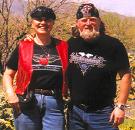
A mom strolls her
baby out into the middle of the colors, hoping he will be overwhelmed as she
is. A biker couple from Ontario, spending their winter months riding Harleys
around the American southwest, would have been the talk of the RV circuit at
Picacho. Here they fit right in.
 |
|
| A biker couple from Ontario would have been the talk of
the RV circuit at Picacho. |
|
 |
|
Once again, the
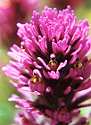
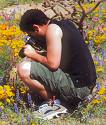
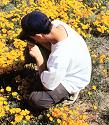
kids aren't bored. You can't see this and be bored. They are all over the
field, shooting close-ups, shooting long shots from down on the ground. They
are disappointed that we have to leave.
My daughter wants
to get one last shot, from the roof of the Suburban, shooting straight down
onto this colorful quilt. "Come on up here," she calls to me. "This would be a
great shot with your lens." I join her and take a few shots.
|
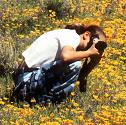 |
| They are all over the field, shooting close-ups down on
the ground. |
|
|
 |
|
When I'm done, I
hand her my camera and slide off the roof to the bumper. And then I hop from
the bumper to the ground.
And I misjudge how
high up I am.
And fall.
Oh how I wish I had
fallen off the roof, for the embarrassment of admitting I've tumbled off a 2
foot high bumper. The kids are instantly hysterical - me on the ground, on my
butt, having hopped to my own demise. My knee swells and immediately turns
color. The kids think it is the funniest thing they've ever watched. They
repeat "You fell on your butt" over and over while we head home, as if they
were 8 years old again.
The 2001 Sonoran
Desert Wildflower season is over. In April, the Palo Verde trees will canopy
the whole city with yellow blossoms. In May, the white saguaro flowers will
tickle us, as desert-dwellers feel an odd pride for the saguaro. From there,
the desert will head into summer, providing sweet red cactus fruit and the
smell of monsoon rain. In the fall, the mesquites will lose their leaves; the
cottonwoods will turn yellow and then do the same.
And then, after the
winter rains, the 2002 wildflower season will be here - that time to pick a
quiet spot under a tree, staring at the beauty and enjoying the
calm. |
|
|
|
Well, probably not.
And
somehow, I like it better that way. |
|
 |
|