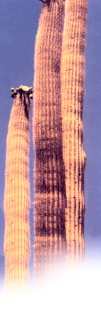
We're not supposed to be
living here, any of us. That's the first irony. This place is not fit for
permanent habitation. When the natives built cities here, it was because there
was water in the Santa Cruz River year round. But when water ran out, they were
always smart enough to move on.
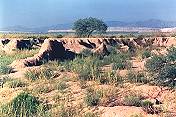
| When water ran out, they were always smart enough to move
on. |
|
Photos by Hildy
GottliebCopyright 2000 © |
Not us. That basic irony,
that we stay where we shouldn't, sets us up for all the other contradictions
and contrasts that make up life in the Old Pueblo.
I've spent my whole adult
life in Tucson, Arizona precisely because I was certain, at age 22, that I
would be spending my life in New York. That starts my own personal
irony.
Just graduated from New
York's prestigious Fashion Institute of Technology, I wanted to see the rest of
the country before spending what I knew would be the rest of my life in the
garment district. Before leaving, I bought enough wool to make 3 suits for
interviewing when I returned and headed out west with my 1971 Dodge Coronet, a
backpack and my sewing machine.
Now it's 20 years later.
Marriage, kid, a business, divorce, another business, friends, lovers, another
business again. The wool, permanently faded along the folds, still sits in a
chest in my living room. New York City is now a place I love to visit, but
Tucson is home.
As for my partner, the fact
that Greek was Dimitri's first language, being born into a Greek-speaking
household in Tucson, Arizona, USA, is great fuel for cocktail party banter. But
Dimitri was raised here by a Greek peasant, who herself had grown up sans
running water or electricity, whose life was tending the fields and feeding the
goats, and who somehow wound up here in the desert, where the mountains remind
her of her home in the heart of the Peloponnese.
Tucson does that. It will
take the son of a Greek peasant, put him in business with someone who knew in
her heart she would never live anywhere but New York City, and not blink. Life
here is always rich, always unexpected.
The desert itself is dry,
unless it's wet, and then it's real wet. In 1983, Tucson's floods were on the
national news, with footage of houses falling into the rushing Rillito River -
the same Rillito that is so bone dry throughout the year that newcomers joke,
"Only in the desert would they call dry dirt a river!" Violent lightning hit 3
boys playing hooky from high school just last week. And the most popular
postcards from Arizona are dramatic shots of saguaros against stormy
lightning-filled skies. Dry as a bone. Unless it rains.
| The desert itself is dry, unless it's wet, and then it's real wet.
|
|
Photos by Hildy Gottlieb Copyright 2000 © |
The desert has cacti with
thorns to impale you, with spines that have a sheath around them, so that when
you remove the spine, the sheath stays inside you to cause pain for weeks. And
then, just up the mountain, there's cool shade and soft pine-laden ground and
ferns so covered in lady bugs that you can't see the green for their red. In
the winter, we head up the mountain, just an hour's drive, to play in the snow,
and then we return to the desert and swim in our pools, all in one day. It's
cold and hot, dry and wet, soft and green and sharp and brown, all at
once.

Photos by Hildy Gottlieb Copyright 2000 ©
|
| Ferns so covered in lady bugs that you can't see the green for
their red. |
|
History itself is
contradiction here. Everyone knows the history of Indians in the west. Over 100
years ago, the army built a fort here in Southern Arizona to keep the Apaches
at bay - Fort Huachuca. 100 years later, Fort Huachuca is still an army post,
and American Indians from all over the United States are stationed there,
preparing to defend the country that took their land. Imagine modern-day Apache
soldiers, training at the very fort that was established just to kill their
ancestors.
Contrast and irony. Until a
year or so ago, downtown Tucson was the home of the world's longest
non-mechanized parade - the Rodeo Parade. There in downtown Tucson, rodeo
riders at one end of the parade would be trotting past Tucson's oldest
skyscraper, the red brick Bank One Building, while horse folk at the other end
of the parade would be winding past the modern red steel sculpture in front of
the modern marble and glass library, leaving a trail of meadow muffins along
our modern downtown streets. School kids in Tucson may not have off for
Columbus Day, but they have 2 days off in February - Rodeo Days. Go
figure.
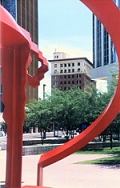
| The red brick Bank One Building, through the modern steel
sculpture at the library. |
|
Photos by Hildy Gottlieb Copyright 2000 © |
In the work we do, we get to
experience the grandest irony of all - the glory in people who are working to
save other people from horror. We get to see the good side of every bad story
in the newspaper, working intimately with the folks who, every day, believe
they can make their piece of the world a better place. No matter how bad the
situation, there are these angels who put their lives on the line every day,
just to make it ok for someone else, and we get to watch them up
close.
These are regular folks -
just like you and me. Volunteer board members who just want the community to be
healthier, or to stop child abuse, or to stop kids from being hungry.
Individual staff members, trying to produce a tv show about the desert or
boxing up food for the housebound. Regular working people who collect diapers
in their offices, year after year, because they know that poor people can't
afford them. Tribal business managers, trying to make a living not just for
themselves, but for the reservation as a whole.
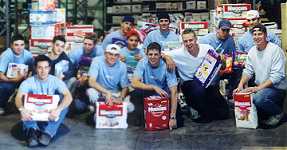
Photos by Hildy Gottlieb Copyright 2000 © |
|
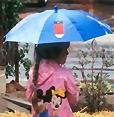
Regular working people who collect diapers because poor people can't afford
them. |
|
It is a culmination of
ironies and contradictions that bring Dimitri and I to the work we do. Each of
us, as idealistic youth, held political jobs that were supposed to
change the world, but wound up just being politics. Each of us has felt that
there has to be a way to take the talents and skills we've acquired over our
working years, and apply them to some greater good. Our talents, these gifts,
are not for us to keep, but for us to give to someone else, or they wouldn't be
called gifts. Maybe that's the ultimate irony.
The gift we receive every day
is that we get to do the work we do, in a community so rich and alive it would
take your breath away. We are excited to show you our home, from all its
contradictory angles. Sit back and let us tell you a story..... |