|
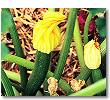
Mamou's life in Greece was sowing
and reaping, shearing and weaving, slaughtering and cooking - a peasant's life.
Everything was dear, and it all came from the earth. Olives were grown and
cured. Greens were grown or picked wild. Her grandkids joke that Mamou's life
was "Feed the goats, eat your dinner, go to bed."
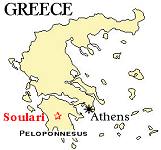 |
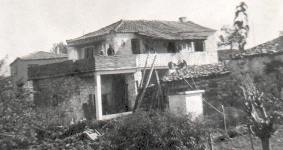
| She and her parents and 5 brothers and sisters all slept in the
single room of their stone house. Below them, the root cellar kept the year's
crops. |
|
 |
|
Mamou carried that way of life with
her from Soulari. When Dimitri was growing up, here in Tucson, Mamou named the
family dog "Pet," which we swear was to differentiate it from those animals she
would kill for supper. Even here in Tucson, she would pick olives wherever she
found them (at the University of Arizona, for instance) and scour the alleys
for dandelion greens. When her children were sick, the cure was a garlic
poultice around the neck. It didn't exactly make them the hit of Roberts
Elementary, but it all made sense to Mamou.
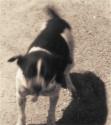 |
| Mamou named the family dog "Pet," which we swear was to
differentiate it from those animals she would kill for supper. |
|
|
She brought blankets with her from
Greece - simple woven wool blankets that don't look like anything special.
These days she's been considering giving them to Goodwill, but Dimitri puts up
a fuss. "Tell her," he says to his mom in Greek, pointing to a blanket
patterned in orange and white. "Tell Hildy how you made this," and she does.
She would start by shearing the sheep. Then she would spin the wool - NOT on a
spinning wheel, but laboriously rolling the wool between her fingers and thumb
until it was a thin twisted length of yarn. The wool was dyed and then woven
into a blanket. This is the "old blanket she doesn't use" that almost went to
Goodwill. No sentiment, only utility. The peasant's way. The gardener's
way.
And what a garden. Tomatoes and
squash and lettuce and dill and always fresh basil (never for cooking, but to
hold and twist and smell the sweet licorice rising from the leaves). Oregano in
such pungent abundance that we all have jars of Mamou's oregano. When I write
out recipes, they specifically call for "Mamou's Oregano."
Mamou's history is Greece's
history. After running the world for a while back about 2000 years ago, Greece
has had one thing after another. They were occupied by the Turks for eons, and
then during this century, there were the Germans and the Italians, and then
their own civil war.
Mamou tells of the shelter they
built in the mountains, to hide the girls when the Germans came. About feeding
the Italian soldiers. About not knowing which was who. And about being a young
girl who saw the "nice young men" with different eyes.
When she was 25, her aunt brought
her to America, to a better life. They came to friends, via Chicago to Tucson,
where she met Tony Peters, and settled into the desert where the mountains
reminded her of home. She raised her boys and her goats and her crops in the
middle of town, learning little English in all those years, still today
speaking with an accent as thick as the dirt.
| When she married, she took the Americanized last name of her husband,
Anthony Petropolis - Tony Peters. |
Stavroula and Tony,February 24, 1952 |
 |
|
Mamou is nurturing and loving and
patient. She is silly and still, at age 75, will laugh at any joke with the
word "poop" in it. She worries about everything and everybody, all the time,
and she truly believes that every person she meets is nice and honest and
sincere. When people are mean, when their motives are not pure, she has to
remind herself that that is even a possibility. In short, she is everything
that makes a garden. And she has given so much of this to her son, who is my
best friend in all the world. Every bit of his spirit, his creativity and
curiosity, his tenderness - it has all been a gift from her.
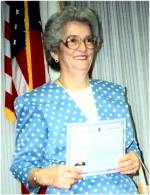 |
| Stavroula Haralamos Fliris Petropolis translates in English to Stella
Harry Peters. But to us, she is simply Mamou. |
Mamou becomes a U.S. citizen |
|
These days, Mamou doesn't have the
energy for much of a garden herself, just some dill, some greens. The tilling
and planting and dealing with the neighbors' cats - it is starting to be too
much. But Dimitri takes her to see my garden, and I bring her my bounty. She
always praises, "How you grow okra? Too hot. I can never grow okra," or "Honey,
that big tomato from you garden?" She is proud of those bushels of vegetables
and herbs, as if she were personally responsible for the earth that created
them - proud that any garden anywhere could produce such abundance.
Mamou went into the hospital on
Christmas Eve. The cancer that started in her breasts has moved to her liver.
She is looking at her life as one would expect - as a farm girl, a peasant, a
gardener. Even in her own illness, she is practical in the knowledge that
everything that lives is certain to die. Even in the hospital, she is far more
worried about her family than herself.
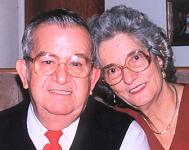
| She worries about everything and everybody, all the time, and she
truly believes that every person she meets is nice and honest and sincere.
|
|
 |
|
I am making a stew for Papou, while
Mamou is in the hospital - chicken and okra, just like Mamou would make it.
There is a little pinch of oregano left in the jar, and I think about keeping
it there, just to remember, but I know this oregano is just what the stew
needs. I hear her voice as I sprinkle in that last little bit, "What you saving
that for? Go ahead - use it. You grow more." Gardens are not particularly
sentimental.
And so, this January, I am thinking
of the garden - planning for plots of okra and tomatoes and basil and oregano.
The seed catalogs have arrived, and my list is growing long. This year more
than ever, I need to plant the garden.
This year, it's for
Mamou.
In loving memory of Stavroula Petropolis
October 27, 1924 -
February 3, 2001 |
|