|

|
|
|
 |
|
|
 |
|
|
|
|
 |
About
Niger
|
|
| Location / Geography / Climate |
|
|
|
|
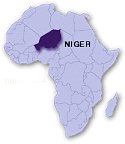
The Republic of Niger is the largest country in West Africa,
encompassing an areas slightly smaller than Texas, Arizona, and New Mexico
combined. Niger’s 760,000 square miles of land are covered by a total of
6,000 miles of road, only 480 miles of which are paved (and Brett tells us that
“paved” is a relative term!). The capitol city is
Niamey.
Niger is a landlocked, arid nation. 80% of the country is desert,
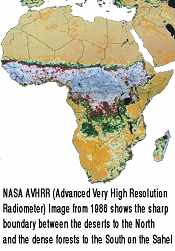 with the northern borders stretching to the middle
regions of the Sahara Desert. The heat can be so intense that rain frequently
evaporates before it reaches the ground. The remaining 20% along the southern
border is made up of dry to semi-fertile savannah (grassland) - which is where
Brett’s village is located. with the northern borders stretching to the middle
regions of the Sahara Desert. The heat can be so intense that rain frequently
evaporates before it reaches the ground. The remaining 20% along the southern
border is made up of dry to semi-fertile savannah (grassland) - which is where
Brett’s village is located.
The land retains enough rain to enable limited agriculture, with
only 3% of the country’s land being arable. The days and nights are hot
except from December to February when the nights get cooler. 95% of the
population lives on rain-fed agriculture, which is, as you will see, how
Brett’s village survives. The CIA’s information site on Niger notes
the country’s natural hazards as “recurring
droughts.” 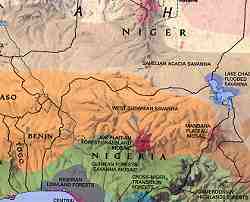
The CIA site further notes the current environmental issues as
overgrazing; soil erosion;
deforestation; desertification, as well as loss of wildlife (elephant,
hippopotamus, giraffe and lion) due to poaching and habitat destruction. (You
will hear Brett talk about his not feeling threatened by large animals, as they
have all been killed off.) |
|
The total population of Niger is
estimated at 10 million people, broken down as follows:
| |
0-14 years: 47.97% (male 2,528,484;
female 2,439,051) |
| |
15-64 years: 49.75% (male 2,518,400;
female 2,633,677) |
| |
65 years and over: 2.28% (male 123,589; female 111,955) |
| Infant
mortality rate: |
| |
123.57 deaths/1,000 live births (2001
est.) |
| Life expectancy at birth: |
| |
41.59 years |
| Total fertility rate: |
| |
7 children born/woman
(2001 est.) |
| Ethnic groups: |
| |
Hausa 56% (Brett’s
village) |
| |
Djerma 22% |
| |
Fula 8.5% |
| |
Tuareg 8% |
| |
Beri Beri (Kanouri)
4.3% |
| |
Arab, Toubou, and
Gourmantche 1.2% |
| |
And about 1,200 French
expatriates |
| Religions: |
| |
Muslim 80%, remainder
indigenous beliefs and Christians |
| Languages: |
| |
French (official), with
Hausa and Djerma (Zarma) being the most dominant native languages. |
| |
A total of 21 languages
are spoken in Niger. |
| Literacy: |
| |
Definition: age 15 and
over can read and write |
| |
Total population: 13.6%
|
| |
male: 20.9% |
| |
female: 6.6% (1995
estimate) |
|
|
Brett frequently talks about Niger as the world’s second
poorest nation. With an annual per capita income of approximately $230 -
that’s all - it is not surprising that 63% of the country is acknowledged
to live below the poverty level.
Niger’s economy centers on subsistence agriculture. Uranium
is its largest export, but that industry has suffered dramatically from
declining world demand. Periodic droughts, resulting in food shortages and
fluctuating export prices, cause instability.
The government primarily relies on bilateral and multilateral aid
- which was suspended following the April 1999 coup d'etat - for operating
expenses and public investment. In 2000, the World Bank approved a structural
adjustment loan of $35 million to help support fiscal reforms. However, reforms
could prove difficult given the government's bleak financial situation. And the
cycle continues.
One of the sure signs of a nation’s level of economic success
can be found in its main consumption items. In a poor nation, consumption
focuses primarily on food, and in Niger, that is the case. Niger’s main
domestic consumption is of the most basic of foods - millet, sorghum, cowpeas,
cassava, and rice. |
| History /Culture /Religion |
|
|
|
In the 19th century, contact with the West began when the first
European explorers searched the area for the mouth of the Niger River. Although
French efforts at pacification began before 1900, dissident ethnic groups,
especially the desert Tuareg, were not subdued until 1922, when Niger became a
French colony.
Niger's colonial history and development parallel that of other
French West African territories. In addition to conferring French citizenship
on the inhabitants of the territories, the 1946 French constitution provided
for decentralization of power and limited participation in political life for
local advisory assemblies. In 1958, Niger became a self-governing republic
within the French Community, and proceeded to full independence in 1960.
One of the observations Brett makes frequently in his letters is
about the interrelation of civil unrest and extreme poverty. The history of
Niger since its independence backs up his observations.
For the first 14 years as an independent state, Niger was run by a
single- party civilian regime under the presidency of Hamani Diori. During the
1970s, the country’s economy flourished from uranium production, but when
uranium prices fell in the 1980’s, Niger’s brief period of prosperity
ended. In 1974, a combination of devastating drought and accusations of rampant
corruption resulted in a military coup that overthrew the Diori regime. An
estimated two million people were starving in Niger. However, 200,000 tons of
imported food, half U.S. supplied, substantially ended famine conditions by
year’s end. Seyni Kountche, a Hausa, and a small group of military
advisors ruled the country until Kountche's death by natural causes in 1987.
Kountche had installed a 12 man military government that administered to every
aspect of the country’s affairs. Fighting corruption and developing
Niger’s infrastructure was at the base of the Kountche administration. He
formed a predominantly civilian government in 1976 before his death. Under
Kountche, Niger built an extensive laterite and tar road system linking each
side of the vast country, west to east to the north.
Kountche’s chief of staff, Col. Ali Saibou, a Songhai/Djerma,
who released political prisoners, liberalized some of Niger’s laws and
policies, and promulgated a new constitution, succeeded Kountche. President
Saibou's efforts to control political reforms, however, failed in the face of
union and student demands to institute a multi-party democratic system. The
Saibou regime acquiesced to these demands by the end of 1990.
New political parties and civic associations sprang up and a
National Conference was convened in July 1991 to prepare the way for the
adoption of a new constitution and the holding of free and fair elections. A
transition government was installed in November 1991 to manage the affairs of
state until the institutions of the Third Republic were put in place in April
1993. The transition government was seen as weak and ineffectual. During its
administration there was confusion over who administered policy and what
authority its implementation had. Teachers and students were typically on
strike for most of 1992 and 1993. Several times during that year armed soldiers
went out on strike across the country, running amok and making demands for
payment arrears without any clear organization or
representation.
In 1993 the country’s first multiparty election resulted in
the presidency of Mahamane Ousmane. The first order of business for the new
government was to recover from the economic crisis. Progress in any area of the
country, however, was delayed by unrest caused by the government’s
inability to pay its employees.
Additional problems were created when the government announced pay
cuts of nearly 25 percent. After settling with the public sector employees, the
situation was exacerbated by the devaluation of the CFA franc by 50 percent,
thereby nullifying any compensation to the public sector employees. Clashes
with police over the payment of grants resulted in the death of one student.
Strikes and violent protests persisted for the next several
months.
The Prime Minister resigned in September 1994. A successful vote
of "no confidence" in the new government resulted in the president’s
dissolution of the National Assembly. Elections were set for mid-January
1995.
Problems arose soon after the elections when one party rejected
the other’s nominee for prime minister. Major conflicts, including a
motion of "no confidence"; continued fighting between the supporters of the
president and those of the prime minister; strikes by teachers, civil servants
and university students; and the eventual rejection of the government’s
budget proposal, blocked the government further. The government of Niger and
the country were clearly at an impasse.
On Jan. 27, 1996, there was a military coup under the command of
Col. Ibrahim Baré Maïnassara. A state of emergency was declared,
the constitution was suspended and political activity halted. The coup leaders
formed an interim government, focused on funding arrangements with the IMF and
the revision of the constitution.
With the help of two independent counsels, which included tribal,
religious and former government leaders, the National Forum for Democratic
Renewal laid out the plans for the revision of the constitution and electoral
code and set the date for national elections. The constitution was ratified by
92 percent of the population that actually voted (only 35 percent of the total
eligible public) and elections were held. Former President Ousmane, former
Prime Minister Amadou, former Speaker of the Assembly Issoufou, and
Maïnassara all contested the elections. However, the military leader of
the 1996 coup, Ibrahim Baré Maïnassara was declared president in a
rigged election.
President Ibrahime Baré Maïnassara, considered a
corrupt and ineffectual leader, was assassinated in April 1999 by his own
security guard. Following his overthrow of Niger’s only democratically
elected government, political unrest dogged his presidency. The prime minister
was retained, and the National Reconciliation Council, responsible for the
coup, promised that elections would follow in nine months. In November 1999,
democratic elections were held. Tandja Mamandou was elected president and
desperately needed foreign aid from France and eventually the U.S. was
restored.
Religion:
Islam began to spread
into Niger in the 10th and 11th centuries, taking root among the aristocracy
and upper levels of the cities. By 1500 A.D., Islam had been introduced to the
Hausa (the tribe of Brett’s village) by Arab traders. Many of the urban
Hausa embraced it right away, in hopes of enhancing their businesses. However,
the villagers were not as receptive to this new religion. In the "holy wars" of
1804 and 1808, the Hausa were conquered by the Fulani, their staunch Islamic
neighbors. At that time, many of the villagers were either forced or bribed
into becoming Muslim. They adopted some of Islam's basic outward behaviors and
rituals, but did not "sell out" as many of the urban Hausa did. |
A
notable thread in Niger’s history is the role of Islam in politics. Prior
to colonization by the French, Niger was significantly influenced by the spread
of Islam. Koranic schools dominated education and a significant portion of the
country converted. In certain areas, most notably the trading capital of
Maradi, pre-Islamic beliefs survived. A blended religion accepted Muslim
elements while maintaining long standing political and religious institutions
embedded in a system of priests and Bori cults. The priests would maintain
order while Allah, as an element of Islam, would ensure health and prosperity
of the community as a whole. While to some degree this religious blending
persists, the treaties with Britain and France, which enabled a peaceful
movement of people to and from Maradi, increased the Muslim
influence.
Today, many of the rural Hausa (Brett’s village) are only
superficially Muslim, and their religious practices have been mixed with local
traditions. They believe in a variety of spirits, both good and bad. Pagan
rituals include making sacrificial offerings to the spirits and to the spirit
possessed. Most rituals are performed by family members, but specialists are
called upon to cure diseases.
The Hausa of Niger have adopted the kulle tradition of Islam,
meaning that they seclude their women. This does not mean total seclusion; they
are free to visit each other in the evenings and go on extended visits to
relatives.
Hausa Culture:
The
people in Brett’s village, Koré Hausa, belong to the Hausa tribe.
The Hausa are originally from "Hausaland," a region covering 75,000 square
miles and straddling the borders of Niger and Nigeria. From 1890 to 1960,
Hausaland was divided into two sovereign states under French and British rule.
After 1960, one became the Federal Republic of Nigeria, and the other, the
Republic of Niger. While French is the country's official language, Hausa is
the language of trade. |
The Hausa are primarily farmers and shepherds, or traders. Markets
are a traditional part of Hausa society, carrying social as well as economic
significance. Male friends and relatives meet there to discuss village affairs,
while young, well dressed single women pass through to see and be
seen.
Most of the Hausa live in rural farm villages with populations
ranging from 2,000 to 12,000. Both inside and outside the villages, one-third
to one-half of the population live in small farm settlements made up of
extended families. These economic kin-based units live under the authority of
the male head of the household.
In marriage relationships, close relatives, preferably cousins,
are chosen as partners. It is a patrilineal society, or one in which the line
of descent is traced through the males. Girls often marry between the ages of
12 and 14.
The Hausa are known for being hospitable to strangers. In Niger,
it has even become a source of national pride. In the Hausa language, one word,
bako, is used to define both "guest" and "stranger."
|
|
According to the U.S. Department of State, Niger’s
constitution prohibits discrimination based on sex, social origin, race,
ethnicity, or religion. In practice, however, there is discrimination against
women, children, ethnic minorities, and disabled persons, including limited
economic and political opportunities.
Women:
The steady
conversion from an independent society to one bound by Islamic influences has
significantly affected the role of women in society. Women were once bound to
society through their socioeconomic roles. They were traders and producers of
cotton thread and cloth, cooking goods, among other things. This gave women a
particular power in their social role within the priestly political systems.
However, the concurrent shift to a cash economy and the rise of Islam has
served to undermine this female role. From the late colonial period onwards,
women have struggled to find a social role of value within the Islamic system
and the modern state. In recent years, women have sought to carve out a new
space for themselves through extra-societal organizations in
Niamey. |
Domestic violence against women is widespread, although firm
statistics are lacking. Wife beating is reportedly common, even in upper social
strata. Families often intervene to prevent the worst abuses, and women may
(and do) divorce because of physical abuse. While women have the right to seek
redress in the customary or modern courts, few do so, due to ignorance of the
legal system, fear of social stigma, or fear of repudiation. Women's rights
organizations report that prostitution is often the only economic alternative
for a woman who wants to leave her husband.
Despite the Constitution's provisions for women's rights, the
deep-seated traditional belief in the submission of women to men results in
discrimination in the political process and in education, employment, and
property rights.
Discrimination is worse in rural areas, where women do much of the
subsistence farming as well as child-rearing, water- and wood-gathering, and
other chores. Despite constituting 47 percent of the work force, women have
made only modest inroads in civil service and professional employment and
remain underrepresented in these areas.
Women's inferior legal status is evident, for example, in head of
household status: A male head of household has certain legal rights, but
divorced or widowed women, even with children, are not considered to be heads
of households. In 1994 the Government considered a draft family code intended
to eliminate gender bias in inheritance rights, land tenure, and child custody,
as well as to end the practice of repudiation, which permits a husband to
obtain an immediate divorce with no further responsibility for his wife or
children. However, in June 1994, when Islamic associations condemned the draft
code, the then Government suspended discussions. The Government has taken no
further action, nor has the current legislature discussed the draft family
code. Islamic militants reportedly threatened women who supported the code with
physical harm.
Children:
Although
the Constitution provides that the State promote children's welfare, financial
resources are extremely limited. The minimum period of compulsory education is
6 years. However, only about 25 percent of children of primary school age
attend school, and about 60 percent of those who finish primary schools are
boys. |
The majority of young girls are kept at home to work and rarely
attend school for more than a few years, resulting in a female literacy rate of
7 percent, compared with 18 percent for males. Tradition among some ethnic
groups allows young girls from rural families to enter into marriage agreements
on the basis of which girls are sent at the age of 10 or 12 to join their
husbands' families under the tutelage of their mothers-in-law. There are
credible reports of underage girls being drawn into prostitution, sometimes
with the complicity of the family.
Female genital mutilation (FGM), which is widely condemned by
international health experts as damaging to both physical and psychological
health, is practiced by several ethnic groups in the extreme west and far
eastern areas of the country. Clitoridectomy is the most common form of FGM.
FGM is not illegal, but the Government is firmly engaged in an effort to
eliminate the practice. The Government is working closely with a local
nongovernmental organization (NGO), the United Nations Children's Fund, and
other donors to develop and distribute educational materials at government
clinics and maternal health centers.
Sub-Saharan Africa is the region most
affected by the HIV/AIDS pandemic. Over 90 percent of HIV infection in
sub-Saharan Africa is transmitted heterosexually. Unlike the U.S. where 20% of
HIV/AIDS victims are women, in Africa that number is over 50% (Over 80 percent
of women worldwide living with HIV/AIDS live in sub-Saharan Africa.)
This situation not only imperils
African women, but their babies as well. At the end of 1999, sub-Saharan Africa
accounted for 92 percent of the cumulative total of the world's AIDS orphans
(UNAIDS defines AIDS orphans as children who have lost their mother or both
parents to AIDS before the age of 15). During that year, nearly 90 percent of
infants who acquired the virus perinatally or through breast-feeding were
African.
These numbers on their own are
staggering. But they are even more so when we are reminded that sub-Saharan
Africa contains roughly 10 percent of the world's population.
As for Niger in particular, 1.35% of
the population is infected with HIV/AIDS. (Compare that to approximately .3% of
the U.S. population that is infected.) 6,500 people died of AIDS in 1999 in
Niger, while in the U.S. in that same year, that number was 15,000.
Niger’s population is 10 million; ours is 276
million.
|
|
|
| BIBLIOGRAPHY |
| |
Great web sources on Niger,
from which
this brief review was assembled, are as
follows. |
|
|
|
|
http://www.bethany.com/profiles/p_code1/1809.html
http://www.qsl.net/niger-2002/
http://www.state.gov/www/global/hman_rights/1998_hrp_report/niger.html
http://www.odci.gov/cia/publications/factbook/geos/ng.html
http://www.studyabroad.com/content/portals/maps/niger_map.html
http://www.newafrica.com/history/niger/history.pdf
http://lucy.ukc.ac.uk/EthnoAtlas/Hmar/Cult_dir/Culture.7844
http://www.newafrica.com/maps/countrymap.asp?countryID=37
http://www.countrywatch.com/files/127/cw_topic.asp?vCOUNTRY=127&TP=HISTO
|

|
|