|

|
|
|
|
 |
How to Treat a Turtle
and Other Things We Learned at
CEDO
by
Hildy Gottlieb
Copyright ReSolve, Inc. 2000 ©
|
| |
It is our first day at
CEDO. We know little about the organization or what they want us, as
consultants, to do for them. We've driven four hours, leaving before dawn. We
have one day to learn as much as we can.
We find CEDO's founder, Peggy Turk Boyer and her
husband/co-director Rick Boyer in a cluttered office, old bedsheets sporting a
seashell motif covering the windows. We learn later that the computer keyboard
is permanently stuck in CAPS LOCK, from sand accumulating between the keys.
This is definitely a NonProfit, living by the sea on a shoestring.
 |
We wend through
the building - dorm space, kitchen, labs. |
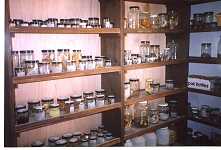 |
We begin with a tour of the facility. As Peggy and Rick explain
what CEDO does and why they are looking for consulting assistance, we wend
through the weather-beaten building - dorm space, kitchen, labs.
But our tour has
suddenly stopped. A group of Peñasco's high school kids has arrived, and
Carlos, a marine biologist and nature photographer who teaches at CEDO, has
begun his talk. I am glad I understand Spanish as he talks about the sea turtle
and its main food supply - jellyfish. "A plastic bag in the ocean looks just
like a jellyfish to a sea turtle," he tells them. "What do you think happens to
the turtle when he tries to eat that plastic bag?" We quickly learn that
choking motions combined with gagging noises are an international symbol,
crossing borders and generations. Curtains. Finito. One dead turtle. We giggle
with the kids, sorry to leave for the next area of our tour.
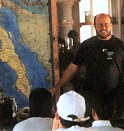 |
| What happens to the turtle when he eats that
plastic bag? |
|
|
We follow Rick and Peggy into the library. They cannot talk about
CEDO's needs without interweaving stories of the people who have visited; of
the changes they have seen in the environment as the rich non-salt waters of
the Colorado River have been detoured away from the Sea of Cortez, routed
instead towards Phoenix and Tucson; of international foundations that provide
quiet support; of incredible research projects with fishermen and teachers.
There is so much to absorb.
But there is commotion in the courtyard. The high school students
have left to look for turban snails and starfish in the tidepools, and a
busload of American retirees is taking their place. They are in Peñasco
from Phoenix for just one day to shop, eat and drink beer, and their CEDO
guide, Felipe, hopes to add a bit of wisdom to their bounty of pottery and
blankets. Felipe gives this free talk twice a week, every week.
| In his retirement,
Felipe teaches at CEDO. |
|
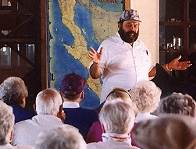 |
Peggy and Rick
whisper that Felipe had been a fisherman who would take university researchers
out on his boat. Along the way, he learned marine biology and English. Now, in
his retirement, this former fisherman teaches at CEDO.
Felipe is showing the group a model
of a dolphin, talking about dolphin intelligence. "Now some people," he starts,
"they think that the dolphin is not as smart as humans, because it has a
smaller brain." The audience nods. This sounds right to them. "But," he
continues, "I do not agree. Because, you see, that would mean that a man that
is bigger than me is necessarily smarter than me. And I cannot believe that is
so!" And he smiles a broad smile.
Felipe leads the group out to the whale bone that is CEDO's
landmark, the 55 foot skeleton of a Fin Whale that had washed up into the
estuary back in 1984. The group has question after question, even as Felipe is
herding them into the gift shop. Here he explains that the building is made
from old tires and soda cans, staying true to CEDO's dedication to the
environment. The gift shop does a brisk business in T-shirts and books, and
Felipe is still answering questions. As they walk out, each of those folks is
talking about something they hadn't realized before.
And in this brief visit, we are
already starting to see that this is what CEDO is - getting through to people
about things they'd never thought of, so that they will do what is right for
the area.
We spend
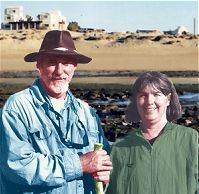
the whole day with Peggy and Rick. They tell us of CEDO's beginnings and of how
they met here at CEDO and then married. They tell us of the challenges of
working in two cultures; that they have incorporated CEDO in both the U.S. and
Mexico, with 2 distinct boards of directors, to ensure that CEDO remains a
voice for everyone involved in the region. They tell us that they scrape by for
everything, that there is sometimes no money for payroll. We share a great meal
in town before heading back to Tucson.
| They tell us of CEDO's beginnings and of how
they met here at CEDO and then married. |
 |
In the car, we feel as if we have lived a month in this one day.
We have gone from curiosity to amazement - from the appearances of a ramshackle
building to the incredible energy of everyone associated with CEDO. We have met
two people who appear to be trying to balance the ecosystem of an entire region
on their shoulders.
We agree to take the job before we've even crossed the border.
This is October of 1997. We have no
idea that we are about to spend an amazing year with these folks. That they
will become our friends. That CEDO's walls will disappear and that its vision
will encompass everything we see, from the trinkets and the fish vendors to the
tiny invisible isopods that will, come summer, nip at our thighs as we sit in
the tide. That we will see the same look of wonder on the faces of American
retirees as on the faces of giggling local kindergartners in their school
uniforms.
Do we
ever know before we are changed that a change is about to happen? I know that
at this point, this first day at CEDO, we have no clue at all. |

|
|
 |
|
|