|

|
|
|
|
|
|
Frequently Asked
Questions
|
How Does CEDO Accomplish Its Mission?
|
| Through research (advancing
knowledge) and education (sharing knowledge). |
|
Advancing Knowledge through Research
 |
CEDO works with the scientific community and with universities in
the U.S. and Mexico
|
|
CEDO
collects data on the tides and the weather, and inventories the creatures of
the tidepools. Its studies of the area over a 20 year period have documented
long-term changes to the ecosystem.
|
|
CEDO
works closely with local fishermen to document the depletion of species in this
fragile region, the topic of an exhaustively researched study recently
published by CEDO.
|
|
Sharing Knowledge through Education
|
CEDO educates tourists. Whether you are into
kayaking, hiking and sliding down sand dunes, or just listening to a talk or
strolling into the tidepools, CEDO's tourist education is never dull. Dancing
yourself knee-deep into quicksand. Holding a turban snail as its hatch closes
up tight. Watching the fiddler crabs hail their mates. Standing at the edge of
a volcanic crater that sinks below rather than rising above the earth. Or
browsing books and maps of the region, in English and Spanish, in their gift
shop and their library.
|
|
CEDO educates local Puerto Peñasco students. In addition to
being a favorite field trip for local schools who bring their students to CEDO
for lessons on the region, CEDO sponsors an annual Community Clean-up
Contest.
|
|
CEDO educates the local community via their Spanish-language
newspaper, Voces del Mar (Voices of the Sea), through radio shows, and through
other public venues.
|
| |
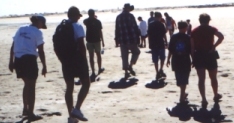 |
CEDO wants you to fully experience the
bioregion they call home. |
|
|
CEDO educates students from the U.S. and other parts of Mexico.
CEDO's field station houses thousands of K-12 school kids each year. CEDO's
staff makes it easy for any school, anywhere, to send their kids to learn about
this incredible region - and they have come from as far as Canada! |
|
CEDO educates real estate developers. Puerto Peñasco is
growing rapidly with golf course resorts and American housing. Both CEDO's
library and their technical assistance help developers approach their projects
with knowledge about the precious resources of both the desert and the sea -
land, potable water (annual rainfall can be as little as 1 inch!), animal and
plant life. |
|
CEDO educates Puerto Peñasco's large
American community with special events to help them understand their adopted
homes. |
|
CEDO educates local small fishermen about
sustainable fishing alternatives. |
|
CEDO educates its supporters. Membership at CEDO includes a
subscription to their quarterly journal, Noticias. With every single article In
both English and Spanish, this scientific journal is written in layman's terms,
to help all of us understand more about what makes this region tick. An issue
might include a story on a visiting class of Tohono O'odham students (whose
reservation is split by the international boundary and whose traditional
homeland included the Peñasco region); a piece about the age of
seashells; and a story about the invasive foreign species of grass taking over
the region's deserts. |
| |
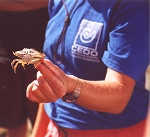 |
CEDO educates by
example. |
 |
|
|
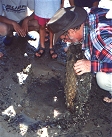
CEDO educates by example. CEDO wants you to
fully experience the bioregion they call home. If their guides pick up a
starfish, you can, too. If they dance and jump to get stuck in the mud, you
can, too. Even their gift shop puts their money where their mouths are - it is
made from old tires and soda cans! |
|
|
Why Do They Take This Approach?
|
| CEDO's
approach connects folks to this region and to each other, confident that once
people see how important the region is, they will protect
it. |
What's So Special About the Region?.
|
| In
addition to the hundreds upon hundreds of species that live in the region, some
of which are specific only to this area, there are things about the upper gulf
of the Sea of Cortez that can't be duplicated |
|
|
Richness of the Sea:
|
|
The mouth of the Colorado River feeds into the Sea of Cortez. The
richness of this gulf region comes from the rich sediment of the Grand Canyon,
along with all the other canyons and river beds along the Colorado.
|
|
Tides:
|
|
The
difference between low tide and high tide in Peñasco can be as great as
30 feet! |
|
|
|
Water Temperature:
|
|
The
average water temperature in the winter is 50º Fahrenheit, and the average
summer water temperature exceeds 90º - a 40º difference in water
temperature! |
|
Example of the
Interconnectedness of Environments: |
|
Over
the years, the fresh (non-salt) water from the Colorado River has been diverted
to major growth areas in the U.S. deserts, areas such as Tucson, Phoenix and
Las Vegas that would otherwise outgrow their water supplies and be left
uninhabitable. This diversion of water has meant that the nutrient-rich water
of the Colorado no longer flows steadily to the Sea of Cortez. This increases
the salinity and reduces the nutrients in the Sea of Cortez, creating the
perfect example of the interconnectedness of our planet's environment - that
building a residential subdivision in Phoenix will affect not only the species
that live in the sea, but the economy of the region as well, as the livelihood
of Puerto Peñasco's fishermen depends on the richness of that sea
life. |
|
|
CEDO is a
NonProfit organization, incorporated in both Mexico and the US. CEDO's founder,
Peggy Turk Boyer, together with her husband, Rick Boyer, run the operations at
CEDO under the direction of two boards of directors - one Mexican, one
American. Thus, the emphasis on "intercultural" in the name - the Intercultural
Center for the Study of Deserts and Oceans.
Peggy's
masters degree in Marine Biology combine with her passion for the region and
for the people living there to make CEDO more than just a place. CEDO is a
sense of connectedness, to the people of this region, and to the environment
that surrounds them.
|
| |
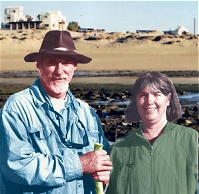 |
CEDO's directors, Peggy Turk Boyer, and her husband, Rick
Boyer. |
Where Does CEDO's Funding Come From?
|
Among the
organizations providing support to CEDO are the David and Lucile Packard
Foundation; World Wildlife Fund; El Pinacate y Gran Desierto de Altar Biosphere
Reserve and the Alto Golfo de California y Delta del Rio Colorado Biosphere
Reserve; U.S. Bureau of Reclamation; Conservation International Mexico; the
Arizona-Sonora Desert Museum; INTEL Corporation; the Robidoux Foundation, Fondo
Mexicano para la Conservación de la Naturaleza, and the Sonoran
Institute. CEDO's efforts are further made possible through the individual
contributions of hundreds of supporters, and through its many gracious
volunteers.
How Can I Learn More about
CEDO?
|
CEDO's website provides some information, but an upgraded site is
being created. Their current site is at
CedoIntercultural.org For
additional information also check
http://herb.bio.nau.edu/~cortez/CEDO.htm
|
|
For as little as $20 ($35 for families), you can become a member
of CEDO, which will provide you with their newsletter and their quarterly (more
or less) scientific journal, Noticias. Noticias alone is worth the $20 (see
"Educating Members," above), not just for its range of in-depth topics, but for
the fact that the entire journal is written in both English and Spanish (a
great tool for brushing up on that 2nd language!) In addition, membership will
get you discounts on excursions at CEDO, if you're ever in the neighborhood!
|
|
|
 |
|
|
|
|
 |
|
|