|

|
|
|
 |
|
 |
|
|
|
|
| |
The
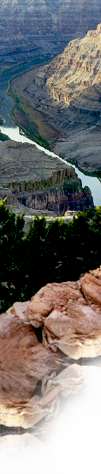
Hualapai Reservation occupies almost 1 million acres at the western edge of the
Grand Canyon, where the Colorado River has widened the canyon walls for a
spectacular view. The reservation winds along 108 miles of the south side of
the canyon, with scenery that changes from desert to grasslands to the pine
forests for which the Hualapai are named - Hwal’bay - the People of
the Tall Pines.
 |
| The government seat for the Tribe is in Peach Springs, along Route
66. There are approximately 1,500 tribal members living on the reservation,
mostly in Peach Springs. Tourism is a major source of income for the tribe.
|
|
|
|
|
|
| |
Hualapai History
 |
| The following is from a report done by
Lizzie Sam, Hildy’s daughter, when she was in the 4th grade. The research
and information is so good, it is included here pretty much as Lizzie wrote it
when she was 9 years old. |
|
The
Hualapais were friendly towards the first white people who visited and settled
in their part of Arizona, and often helped them. In 1776, Father Francisco
Garcés came to the Hualapai’s homeland. He had a friendly visit and
then moved on. This made the Hualapai aware of other people besides the
Indians.
In the 1850's and 1860's, miners
came and threatened the Hualapais’ way of life. At the same time the
miners were taking their land, other outsiders came to take the Hualapais as
slaves. After a number of their leaders were killed, the Hualapai took up arms
against the outsiders. They killed every miner they could find. The army came
to stop them. They killed Pai wherever and whenever they could be surprised,
burning their camps when the Indians fled. For 3 years, from 1866 - 1869, the
Pai defended their land, but eventually were defeated.
The Long Walk or The Trail of Tears:
The Hualapai were defeated by U.S. troops. By 1874, the
survivors were herded into a camp near Parker, on the Colorado River
approximately 125 miles from their homeland, where many more of them died. They
died because there was not enough food at the camp, because farming conditions
were not what they were used to. They also died from disease.
Those who survived went against orders and
marched across the 125 miles of desert back to their homeland. They found it
taken over by miners and cattlemen. The Hualapai hung around the camps and
settlements of the outsiders, taking unskilled jobs and abuse from them.
After they got back from Parker, they were
allowed to occupy a small part of their original lands. This area became the
reservation in 1883.
Dwellings and
Language:
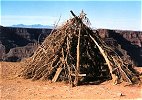
The Hualapai lived in domed huts
made of poles, brush and earth, as well as temporary brush wikiups. Sturdier
winter houses were sometimes built. Rock shelters were often used to live in.
Sweat lodges were commonly used, and rectangular flat-roofed ramadas were
occasionally built for summer shade.
The
Hualapai language is one of the Yuman languages, also including the Yavapai,
Havasupai and Mohave Indians.
(Aside: For more details and a fascinating account of
the horrors of the Hualapai War, check out the story from Dan W. Messersmith on
behalf of the Mohave Museum of History and Arts, at
www.ctaz.com/~mocohist/museum/beale.htm
By Mr.
Messersmith’s account, “It is estimated that over a full one-third of
the Hualapai people were killed during this war, and yet, it would take several
years of hard effort to subdue the Hualapai and then only through starving them
into submission.”)
|
|
|
| |
ReSolve’s Work at Hualapai
ReSolve was initially retained by
Hwal’bay Ba:j Enterprises, the commercial arm of the Hualapai Tribe, to
prepare an economic feasibility study for what was initially intended to be a
30 room Motel 6 type facility in Peach Springs, to accommodate River Running
traffic. Using the feasibility study and working with Richard Fe Tom and the
architects from Tucson’s “The Architecture Company”, the hotel
was expanded to 60 rooms, and became the beautiful Hualapai Lodge. The Lodge
has a restaurant and is the home of Grand Canyon River Runners, the
Hualapai’s River Rafting company.
ReSolve’s work expanded to creating strategic operational
plans for all the tribe’s tourism enterprises - its Grand Canyon overlook
at the West Rim; its river rafting operations through Grand Canyon River
Runners; its T-shirt manufacturing operation; its big game hunting operation;
and finally the corporation as a whole. The work took a year to complete,
during which time ReSolve was contracted to provide executive search services
for the corporation’s general manager, as well as an RFP for construction
management.
Working with the Hualapai tribe
was one of the most rewarding experiences either of us has ever had. We made
friends and shared experiences we wish all our friends could share. It is
because of the impact the Hualapai people have had upon us that we have created
these pages - as a tribute to a pretty amazing people in a pretty amazing
place.
We would love to give special thanks
to our friend and mentor, but the first serious conversation we ever had with
him included his request not to be given public thanks or credit. We’re
not real sure we’ll be able to do that as our stories unfold, and we hope
he will forgive us, or at least let us buy him dinner to make up for our
misstep!
|
|
|
|
 |
|
|