|

|
|
|
 |
Rolling on the River
by
Hildy Gottlieb
Copyright ReSolve, Inc. 2001 ©
|
I am agonizingly wet and cold. We
are on a raft in the Colorado River, where the water stays at 45 degrees year
round.
My whole body is shaking, and I'm
thinking that dying right now would be ok. My thoughts travel back to the time
my then-husband, a championship diver, almost drowned jumping into a mountain
pool. He hadn't realized the frigid water was really snow run-off, and the cold
completely disabled him. I am thinking of this, and of dying, here in the
frigid cold Colorado River, inside the walls of the Grand Canyon, on a raft.
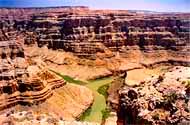
| We are in the frigid cold of the Colorado River, inside the walls of
the Grand Canyon. |
|
 |
How did a Jewish girl
from the suburbs of New York City, a kid who took piano lessons and wrote
poetry - how did that girl wind up ready to die on a raft in the muddy
Colorado? I don't know how to explain it any other way - I'm a consultant.
We are working for the Hualapai Tribe,
helping them improve their tourism businesses and thereby improve the tribe's
lot overall. We can't very well advise on a business without experiencing it
firsthand, and so we're here. Dimitri has brought his two boys, aged 12 and 9.
My daughter, the most adventurous of all of us, is back at the hotel with strep
throat and 101° temperature, being attended to by Dimitri's wife, the
nurse. |
|
The day starts early, in the
Hualapai community of Peach Springs. About 25 tourists gather into two vans,
where a tribal member will drive us straight into the Grand Canyon. The
Hualapai have the only road that allows you to drive from the top of the canyon
into its belly, and the ride has everyone in the van - Americans, Germans,
French - pointing and ooohing. Fields of cacti, puffy clouds against a
perfectly blue sky, all surrounded by the canyon's red walls. The van kicks up
a rock, and the driver quietly confides, "It's the little people. They play
tricks all the time." There is no sign that she doesn't mean
it. |
By the time we are at the bottom,
we have crossed streams where the women traditionally found reeds for making
cradle boards, and where many of their healing herbs grow. We have left the
serenity of the canyon ride, arriving at the sparkling energy that will last
the whole rest of the day - the rushing Colorado River and a crew of Hualapai
guides who have readied their rafts for us tourists.
| |
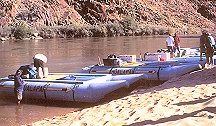
| The Hualapai guides have readied their rafts for us
tourists. |
|
 |
|
I'm feverishly taking notes,
jotting down what everyone says, employees and customers alike, and noting our
ideas and observations. The guides explain that the rafts are motorized - that
the Hualapai lands are located so far west along the canyon, that there are
only 9 rapids to maneuver. The motorized rafts make for a fast exit once the
river calms and widens. I am jotting down everything they say. Only when Drake
and Reggie, our guides, tell us to put everything of value into the wet-pouches
so they don't get soaked do I realize I will need to remember much of what we
do, as writing won't be an option.
We aren't
far from the start when Drake gives the "Are you ready?" signal, and we plow
into the first rapid. A roller coaster, a joyous thundering into the extremes
of what life can be. It's GREAT! I'm the Jewish kid from the sidewalks of New
York and it's GREAT! |
Drake asks, "Want to do it
again?" And because the raft is motorized, we turn around, head back UP the
river, and plow BACK into that same rapid. If we'd wanted to, we could have
played on that one rapid all day long!
After
20 years on the river, Drake is the consummate tour guide - cajoling and
bringing out the best in all of us, all while maneuvering the raft as if it is
simply an extension of his arm. Later in the afternoon, we will learn just how
well he knows the river, the boat, and his passengers, when he points out a
whole family of big-horn sheep, making their way along the rocky canyon wall,
looking for food and water. "There's been so little rain," he will tell us,
"that they're coming down this far, just for water." The brown of their hides
will blend with the brown of the rocks, and it will take us a while to focus on
what Drake will find with barely a glance. He will circle the raft closer and
then closer, so we can take pictures. And we will be impressed with everything
about him. |
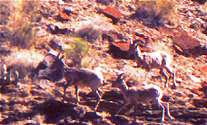 |
| Our guides are great. Drake points out bighorn
sheep, while Reggie learns the ropes. |
|
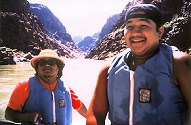 |
Drake's partner on
this ride, Reggie, is enthusiastic about his first year on the river. He is
thrilled at every rapid, and spends every spare minute looking at maps of the
area, trying to absorb everything he can. Drake lets him learn by his mistakes,
all the while guiding him away from potential harm. We feel safe with them
both.
Between rapids, Reggie and Drake talk
about Hualapai history, about a canyon life of foraging and hunting. They tell
us about geology. They explain the things we need to know for our work, about
the operations of this enterprise - what works well and what doesn't. And we
can't write any of it down.
But it doesn't
matter. Because the only words that come are silly words, the ones English
teachers caution not to use. Words like amazing. Incredible. Breathtaking. How
do you describe a waterfall you can see, but is no longer there - layers and
layers of minerals, hundreds of feet tall, from water that floated for so long
over the same rock, year after year, that it has left a waterfall of rock long
after it dried up? Neither words nor camera can capture what it felt like to
see it.
| How do you describe a waterfall you can see,
but is no longer there? |
|
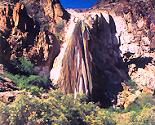 |
We are at
Travertine Falls, and the boats are docking. The guides scramble ahead, we
tourists following slowly along, gaining our legs back with each step.
When we catch up with them, we are at the bottom of
a small waterfall. And dotting the whole rocky path to the top are our guides,
stringing a rope between them to support us tourists as we climb along towards
the top. A human guardrail, supported only by the muscled arms of our Hualapai
guides. When everyone has pulled themselves up along the rope to one landing,
the guides scramble further upward, stringing the rope alongside them. We climb
in that fashion, hand over hand, guide by guide, to the top of the falls, where
there is a small cave to explore.
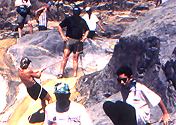 |
| We climb along the rope, hand over hand, guide
by guide, to the top of the falls. |
|
This human
interaction is a hit with the group, who are already overloaded with
stimulation - waterfalls and climbing and rapids and adrenaline and displays of
muscle. They are tickled.
The consultant is
suddenly conflicted, though. Am I scared to death at the liability of this
display, or thrilled that the crowd is so pleased? Then just as suddenly, I am
one of the tourists again, impressed by the combination of beauty and brawn.
The consultant goes on her break and leaves me in her place to just
enjoy.
And now we are back on the river,
battling another rapid.
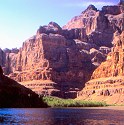
What contrast! What
joy! Exhilaration and fear, adrenaline and ice ice cold water. And then this
grandness, this beauty. Ribbons of color, stripes both vertical and horizontal
- the red of iron, the green of spring, the so-many different shades of brown
that one couldn't imagine brown to be so interesting. Rocks that have been
whittled by water and wind and sand, smoothed to look like a thousand bubbles,
glistening along the canyon walls in the sun.
| Rocks that look like a thousand bubbles,
glistening along the canyon walls. One can't imagine brown could be so
interesting. |
|
 |
And then, just as
you have opened your eyes so wide, trying to take it all in, you hear, "Ready?"
and you are submerged again, your heart racing. How can you feel so many things
all at once?
We've gone through the last of
the rapids. Drake tells us to put on dry clothes. But we had thought the 90
degree sun at the bottom of the Grand Canyon would be enough to dry us. We
didn't bring any dry clothes.
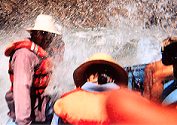
And now the
boat is kicking up a mist that keeps us constantly wet and windy and 45
degrees. It is so cold and so wet that I know I am going to die. The cold lasts
for an eternity, or probably about ½ hour, which is about the same. I am
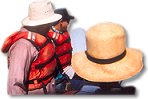
suddenly concerned about my hat, of all things. I bought this straw hat just
for this occasion, and its beautiful designer shape had come undone after the
first rapid submerged us. My designer hat is a straw blob now, tied to my head.
I will die and look horrible.
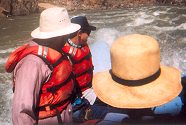 |
| Then you hear "Ready?" and your heart is
racing. How can you feel so many things all at once? |
|
 |
Finally, we dock at
Spencer Canyon for lunch, and I find the sun, stretch out, and pray for warmth
to overtake me. After 20 minutes, the shaking has stopped, and I can open my
eyes to what I've been missing in the fetal position on the
boat.
The beach at Spencer Canyon is lush and
green. That means a lot to us desert folks. Creeks and reeds and the tamarisk
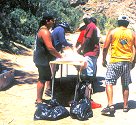
trees that suck water. The consultant notes the swiftness and efficiency with
which the guides set up lunch. Splash guards have been converted to tables.
Boat seats hold the food.
But I realize I am
ravenously hungry, and the consultant is gone again, as quickly as she'd
appeared. The sandwiches and cookies are better than any five-star meal I've
ever had. Everyone else obviously feels the same; there is nothing left to pack
out except the trash.
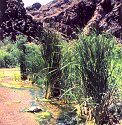 |
| The beach is lush with creeks and reeds. The
guides swiftly and efficiently set up lunch. |
|
 |
We'd heard that the
afternoon is considered by real rafters to be "hot and boring." There are no
rapids, and the boat just tools along for a few hours, continuing to wend
through the canyon towards the take-out point at Pierce Ferry.
Boring is the last thing I'd call it. The sun
is delightfully warm. This morning I never thought I would ever be warm again.
Now our clothes have completely dried. We are stripping down, lathering up with
sunscreen, as we raft past so many cliffs and rock formations that we are no
longer pointing and ooohing, just looking around quietly and relaxing. After
the thrill of the morning, the afternoon is lazy. We rest, and the sun and the
breeze are a blessing.
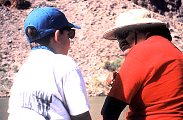
Before the kids can
get bored, Drake tells stories and jokes with them. He befriends Derek, the
youngest, with all kinds of silly hand games and tricks. Mito, being older, is
content to see how the underwater camera works, and to learn about the people
who lived in this canyon for so many centuries before rafts and picnic
spots.
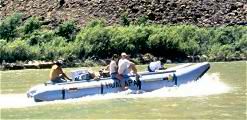 |
| The afternoon is lazy. Before the kids get
bored, Drake jokes with them. |
|
 |
It's around 4:30
when we load back into the vans that took us down to the river in the morning,
this time to take us back to our cars. Everyone is asleep before the engine is
even turned on. But the consultant is at work again, writing feverishly
everything that might be forgotten, interviewing the van driver, thinking about
efficiency and maximizing tourism opportunities. I fall asleep moments before
we arrive at Peach Springs.
As we head back to
our hotel, the boys are quiet. They are exhausted but awake. Mito looks up and
says, "It's too bad Lizzie was sick. She would have loved this. She's Adventure
Woman." He's right. My daughter would have counted this as one of the
highlights of her young life.
And the kid
from New York with the piano lessons? The consultant with the notebook and the
camera? I learned what it means to be Adventure Woman that day, if only just a
little.
And I can't wait to go
back.
|
The Hualapai
are booking tours now for Summer 2001
CLICK
HERE for info |
|
|
 |
|
 |
|
|